Two Important Ingredients That Aren't in the Bottle
by CBS Founder Jono Reilly
When people start a hot sauce company, they tend to obsess over the obvious things: The recipe. The heat level. The bottle. The label. The price.
These are all important. But after making hot sauce professionally for 14 years, I have realised that two of the most important ingredients in a hot sauce business aren't actually ingredients at all.
The brand, and the chili supply. Both are often underestimated.
A recipe can be copied, as can bottles, labels, design style and other original concepts. Even manufacturing can be outsourced.
But if you lose control of the name people associate with your product, or you lose access to the chilis that make the product what it is, you can find yourself in the unfortunate situation of owning a hot sauce company without really controlling what makes it different to everything else on the market.
The three biggest names in the chili world give us three different lessons about this: Tabasco, Sriracha and the Carolina Reaper.
Tabasco - The Brand (How to do it)
Tabasco is probably the most successful hot sauce brand in history.
McIlhenny Company has been making TABASCO Sauce on Avery Island, Louisiana since 1868. Today it is sold in almost every part of the world. The basic recipe is still remarkably simple: peppers, vinegar and salt. The process is what makes it special: more like a single malt scotch than a pepper sauce.
Edmund McIlhenny did not actually invent the Tabasco chili. The name existed independently of him: Tabasco is a state in Mexico, and it also became the name for a pepper variety which supposedly originated there. This created a fairly serious trademark problem.
How do you own the name of your sauce when the name also describes the thing its made from? The name Tabasco sauce could be compared to tomato sauce, a simple description of the product. The McIlhenny Family spent decades on this problem.
Other companies inevitably began producing sauces from tabasco peppers and calling them tabasco sauce. McIlhenny fought them through the courts, arguing that whatever the word meant geographically or botanically, consumers had come to associate Tabasco sauce specifically with the product from Avery Island. Eventually, that argument worked, and is one of the earliest and most detailed examples of the importance of trademark protection.
In one 1928 case, a court recognised that McIlhenny's long use of the name had created a public association between Tabasco sauce and McIlhenny's product, while still allowing competitors to truthfully describe sauce as being made from tabasco peppers as long as they clearly distinguished it from McIlhenny's sauce. The important point being made was that McIlhenny didn't need to own the pepper. He needed to own what the word meant on a bottle of hot sauce.
And over the following century, the company became extremely good at protecting that meaning. Today its trademarks extend beyond the word TABASCO to the familiar diamond label, bottle design and other elements of the brand. There are many similar products, but none of them look like TABASCO.
Tabasco - The Pepper (How to do it)
But Tabasco also understood the second half of the problem: You need peppers, and not just any old peppers. You need your peppers.
Every year, the McIlhenny family selects the best plants from its crop and keeps their seed for the next generation. Seed grown on Avery Island is supplied to farmers elsewhere in the world, and McIlhenny supports those farmers with multi-year purchasing contracts and agricultural support.
That is a much more sophisticated relationship with a raw ingredient than simply buying whatever happens to be available on the wholesale market. It gives McIlhenny a level of control over the genetics, consistency and supply of the chili at the centre of the product.
So Tabasco has spent more than 150 years protecting both the brand identity, and the chili supply.
Sriracha - The Brand (How not to do it)
Then there is Sriracha. More specifically, Huy Fong Foods' Sriracha: the red sauce in the clear bottle with the green cap and rooster on the front. David Tran founded Huy Fong Foods in California in 1980 and developed his version of a sauce whose origins came from his home hearth of Thailand. He called it Sriracha, after Si Racha, the Thai coastal town associated with the sauce.
It became one of the most recognisable hot sauces in the world.
But for some reason, Tran never secured exclusive ownership of the name Sriracha. Instead, he protected other elements of the product. The rooster became a trademark, as did other parts of its visual identity. But not the single word everyone actually used to describe the sauce: Sriracha.
This was partly because “Si Racha Sauce” was already the name of a type of sauce and derived from a geographical place. Exclusive trademark rights would therefore have been difficult, but it seems he didn’t even try. He famously regarded other companies using the word Sriracha as free advertising for the category, and there is a certain logic to that. Unfortunately it didn’t work out so well. There are a thousand brands of Sriracha, and most people don’t know that his is the original one. Tabasco makes Sriracha. Flying Goose makes Sriracha. Supermarkets make their own Sriracha. There are Sriracha crisps, Sriracha mayonnaise, Sriracha peanuts and almost everything else you can think of, from lip gloss to candles.
Sriracha - The Pepper (How not to do it.)
For almost three decades, Huy Fong's peppers came primarily from one supplier: Underwood Ranches in California. The relationship began in 1988, when Huy Fong bought around 500 tons of jalapeños from Underwood. As Huy Fong grew, Underwood grew with it.
By 2006, Underwood was supplying around 95% of Huy Fong's peppers. Huy Fong encouraged the farm to increase acreage, and Underwood invested millions in land and infrastructure to keep up with demand.
For years, this worked extremely well. It was actually one of the reasons Huy Fong's sauce was so consistent. Underwood wasn't just selling them generic jalapeños. They had developed an agricultural operation around producing huge quantities of the particular ripe red peppers Huy Fong needed. Then, in 2016, the relationship collapsed over a financial dispute.
After much wasted time and money on court cases that could have been avoided, Huy Fong had lost its only chili supplier. This is a bigger problem than it may seem. Peppers need to be the right variety. They need to reach the right colour and maturity at the right time. They need to be harvested and processed quickly. And if you need tens of millions of kilos of them, someone needs to plan all of this months or years in advance. Underwood had spent decades building that system alongside Huy Fong, and it couldn’t simply be replaced by another supplier.
After the relationship ended, Huy Fong began sourcing from multiple growers in California, New Mexico and Mexico. In the following years the company suffered repeated chili shortages and production interruptions. In 2024 it suspended production again because the peppers available to it were too green to produce the expected colour of the sauce. They continued trying to sell a sauce that was known for its vibrant red color, which now had a colour that many online reviewers were describing as "baby poop brown”.
Underwood, meanwhile, started making its own competing sriracha sauce. Their slogan is “The peppers make the sauce.”
Crazy Bastard Sauce - The Brand (what I’ve learned)
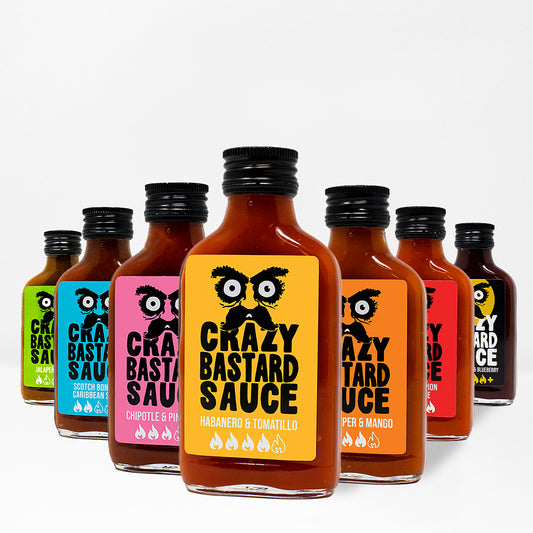
Over the years at Crazy Bastard Sauce I've had my own problems with both trademarks and chili supply, and I’ve learned how important both are, above everything else.
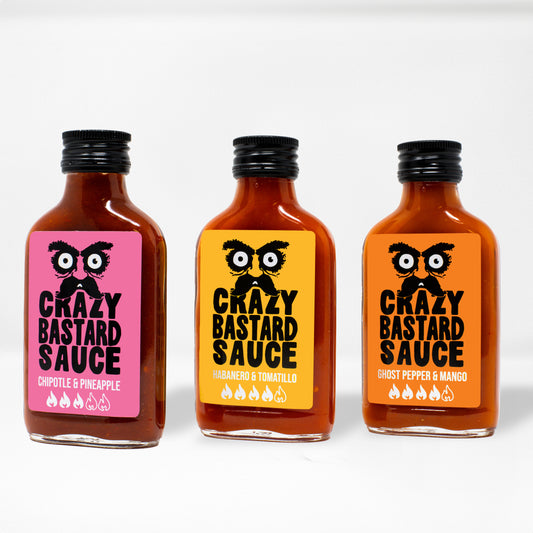
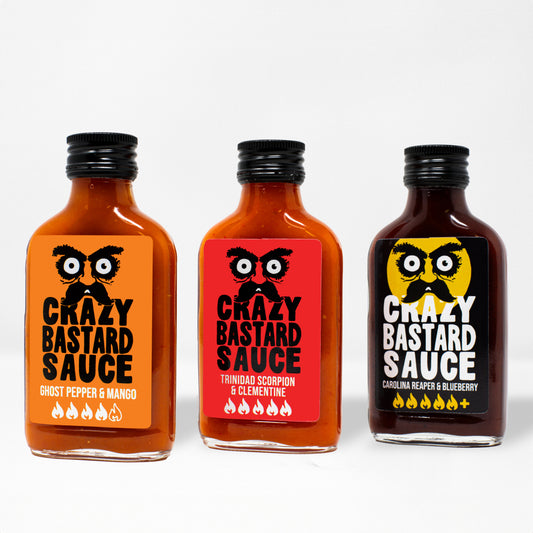
I started making hot sauce because I love hot sauce, but I continue to do it because I made a brand that worked from day one. The logo on every bottle is still the same version of the logo that I drew by hand in 2011. I have learned that this one of the most valuable assets of the business, and the only one that you can protect. But also that its only worth protecting if you make a product that people love.
I also learned that if you don’t actively protect it the was TABASCO did, you can leave it open to everyone else like Sriracha did. We have had to protect our trademark twice from being appropriated by much bigger companies, and we have won the case both times. On two other occasions we decided not to challenge newer companies who had similarities with our brand, which has probably weakened our claim to the brand when future disputes arise. Unfortunately that is how trademark law works, if you don’t fight for your brand identity you run the risk of losing future fights.
Crazy Bastard Sauce - The Peppers (what I’ve learned)
Our supply of top quality, ripe and super hot chilis took years to set up. The quality of our products depends on it. Sharing that chili supply with other producers, just as TABASCO does, helps us to maintain it. The growers don’t want to rely only on us.
A reliable supplier is not just someone who sells you ingredients, and a brand isn't just the artwork you put on the bottle. Both are assets that make your products what they are, and both can disappear surprisingly quickly if you don't take care of them.
Ed Currie / Puckerbutt / Carolina Reaper - The Pepper is the Brand
Ed Currie's story combines both problems in a particularly interesting way. Because unlike McIlhenny or Tran, Currie actually created the chili himself. Currie spent years selectively breeding superhot peppers in South Carolina. Eventually he produced the chili that became the Carolina Reaper. In 2013 Guinness World Records recognised it as the hottest chili in the world.
Carolina Reaper is an excellent name. It tells you where it comes from and what it intends to do to you. The pepper became enormously famous. Hot sauce companies started making Carolina Reaper sauces. Snack companies started making Carolina Reaper crisps. People grew Carolina Reapers all over the world. You could buy Carolina Reaper seeds almost anywhere, including from Ed Currie. And this is where the lessons from TABASCO and Sriracha come together.
Currie had created an incredibly valuable pepper, and then helped distribute its genetics around the world. At the time, this made sense. PuckerButt was in the seed business. People wanted Carolina Reaper seeds. Selling them produced money immediately. But once the seeds were out, controlling the pepper became extraordinarily difficult.
Currie has since said that he essentially "gave" the Reaper to the world and watched other manufacturers make money from it. Even ten years after the world record, PuckerButt itself was still selling tens of thousands of seed packets per year (including to us, for our pepper supplier to grow).
The Carolina Reaper had become more than a chili variety, it had become a brand, and Currie had learned that the two things couldn't really be separated. His skill in chili growing created the pepper, but the name created the commercial value. If somebody else could grow the genetics and use the name, they could benefit from both without necessarily buying anything from him.
Ed Currie / Puckerbutt / Pepper X - The Brand is the Pepper
So when Currie developed his next record-breaking pepper, he took a very different approach. Pepper X took more than a decade of selective breeding to stabilise. In 2023 Guinness World Records officially recognised it as the new world's hottest chili, nearly 50% hotter than his first record.
As of 2026, PuckerButt still does not sell Pepper X seed to the public. The company says the variety is protected, and Currie has instead released Pepper X commercially in processed forms such as mash and powder. You can buy the heat and the flavour of Pepper X, but you can’t buy the seeds. He learned the lesson of the Carolina Reaper: Don't sell the factory.
This also explains the secrecy around where some of his peppers are grown. Currie has said people have attempted to steal plants from his farms, and reporting around his operation describes secret greenhouses and multiple growing sites used to keep the valuable genetics protected. There are also stories in the chili world about decoy farms and armed security. Those details are harder to verify, but the story makes sense. He is protecting the brand and the pepper, which in his case are the same thing.
History repeating
On a fun tangent, this reflects a strangely similar story involving another member of the nightshade family. The potato.
In eighteenth-century France, potatoes had a terrible reputation. Many French people considered them animal feed, or thought they were unhealthy. Antoine-Augustin Parmentier, a French pharmacist who had survived on potatoes while imprisoned during the Seven Years' War, became determined to change that. He spent years promoting them, hosting dinners featuring potatoes in multiple courses, and giving potato flowers to as gifts to prominent people. According to the famous version of the story, he planted a field of potatoes outside Paris and had it conspicuously guarded by armed security. People naturally concluded that anything worth guarding must be valuable. Then, on his orders, the guards were removed at night, allowing locals to steal the potatoes and plant them themselves.
This story may have grown somewhat in the telling, but Parmentier genuinely used publicity stunts to promote potatoes and deliberately planted a large crop near Paris knowing people would steal from it.
The similarity to the Pepper X story is uncanny, but with opposing intentions: Parmentier wanted the public to steal his potatoes because every stolen potato spread the crop. Currie presumably wants exactly the opposite.
The Hot Take
The idea of ownership has changed dramatically since TABASCO was founded. But the central question remains the same: what can you actually call your own?
A trademark can protect a name, a bottle or a symbol, and TABASCO spent more than a century establishing just how valuable that protection could be. But a brand is only as strong as the product behind it, and in the case of hot sauce, that product ultimately depends on something much harder to control: the chilis themselves.
You can patent processes, register trademarks, control supply chains and protect genetics. You can even claim legal ownership over certain plant varieties. But legal ownership and biological control are two very different things.
Life, uh … finds a way.
So if you can never completely control a chili, how do you make it yours? Perhaps not by preventing it from spreading, but by becoming inseparable from its story. By nurturing it, sharing it and embedding it in culture so deeply that even when the plant escapes your control, its history doesn’t. Parmentier understood that with the potato. He wanted the plant to escape his fields. Ed Currie's strategy with Pepper X is almost the exact opposite. Commercially it makes perfect sense, but biology has no respect for intellectual property. Eventually all it takes is one viable seed to be ingested by a wild bird, and deposited miles away in a perfect fertiliser, as nature intended.
Perhaps this is where ownership finally runs out. You cannot completely control what grows. You cannot completely control what competitors do. You cannot even completely control your reputation or brand, because reputation exists only in other people's minds.
What you can control is the behaviour that creates it. Your integrity. Your respect for the ingredients you use, and the relationships you build with the people who grow them. The promises you make under your name to customers and suppliers alike. A trademark can protect the name and the reputation attached to it, but a name and a reputation are only worth defending if you've earned them.